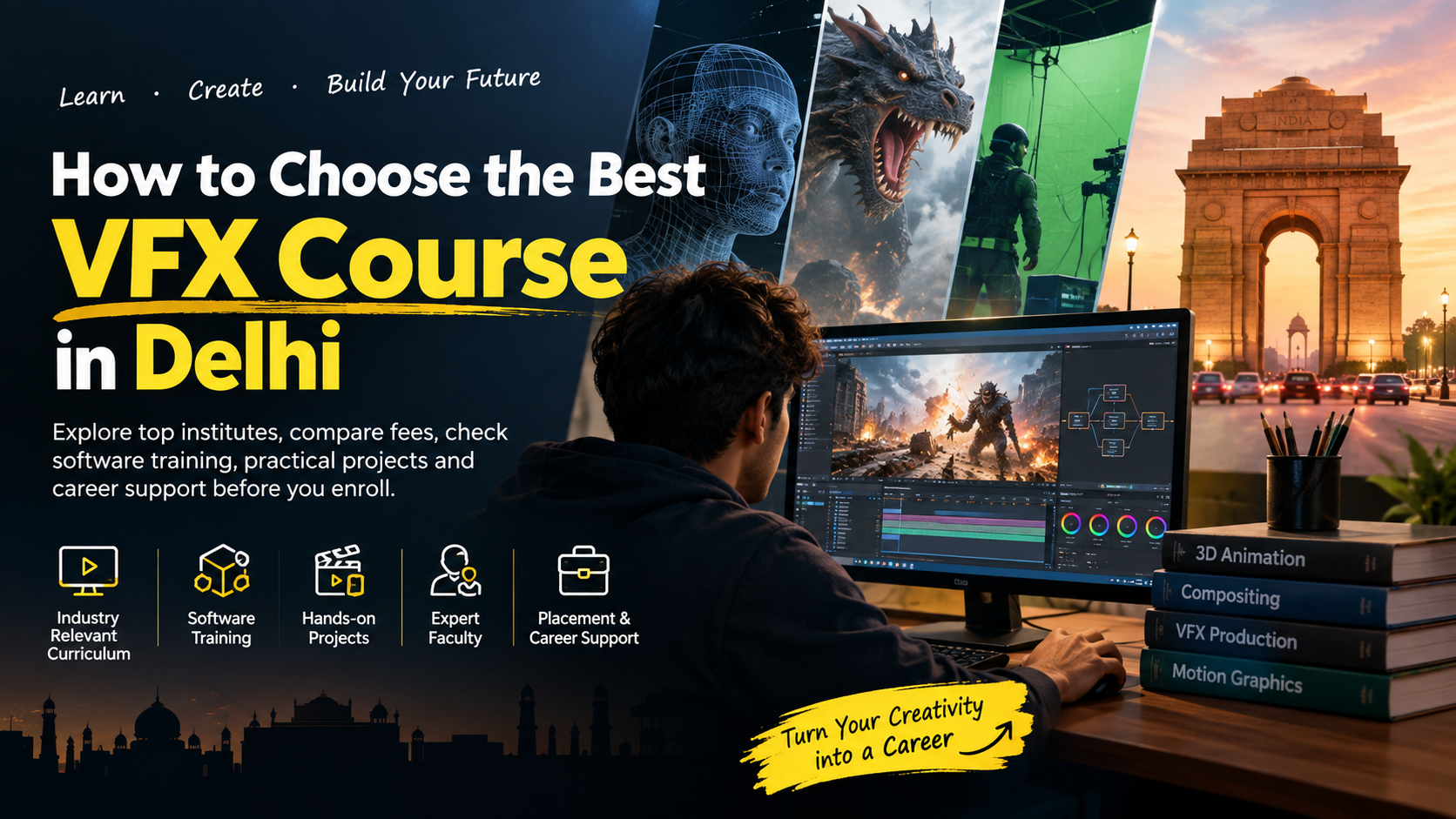
How to Choose the Best VFX Course in Delhi
Choosing the right VFX course in Delhi can be an important decision for students who want to build a career in visual effects, animation, film production, gaming, advertising, or digital media. Delhi has many institutes offering VFX and animation programs, but the course structure, practical training, software, faculty, duration, and career support can vary significantly.
Instead of choosing a course only because of its popularity or low fees, students should compare different factors before taking admission. A good VFX course should provide practical knowledge, industry-relevant software training, project experience, and guidance that helps students understand how VFX work is created professionally.
Why Choose a VFX Course in Delhi?
Delhi is a major education and media hub with many institutes offering courses related to animation, VFX, graphic design, filmmaking, and digital media. Students can find both short-term courses and longer professional programs depending on their career goals.
A VFX course in Delhi can introduce students to different areas of visual effects, including compositing, rotoscoping, 3D modelling, texturing, lighting, motion graphics, and other production techniques.
Studying in Delhi can also provide opportunities to attend workshops, interact with other creative professionals, and explore internships or entry-level opportunities in the media and entertainment industry.
What to Look for in a VFX Course in Delhi?
Not every course provides the same level of training. Before selecting an institute, students should carefully examine the curriculum, practical training, software, faculty, projects, and other facilities.
Check the VFX Course Curriculum
The curriculum should cover the important fundamentals of visual effects as well as practical production techniques. Look for topics such as compositing, rotoscoping, keying, tracking, 3D modelling, texturing, lighting, rendering, and motion graphics.
A well-structured curriculum should gradually move from basic concepts to more advanced projects. Students should also check whether the syllabus is regularly updated according to current industry practices.
Check Software Training in the VFX Course
Software knowledge is an important part of professional VFX training. Before joining a course, check which software applications are included in the curriculum.
Depending on the course, students may learn tools used for compositing, 3D design, animation, editing, and motion graphics. The exact software can vary between institutes, so students should compare the software training rather than assuming every institute teaches the same tools.
Look for Practical VFX Training
VFX is a practical field, so classroom theory alone is not enough. A good course should provide regular hands-on assignments and projects.
Students should have opportunities to create their own visual effects shots, practice compositing techniques, work with 3D assets, and understand the different stages of a VFX production workflow.
How to Compare VFX Institutes in Delhi?
After identifying a few institutes, compare them using practical factors rather than choosing immediately.
Check Faculty Experience
Experienced instructors can make it easier for students to understand complex VFX concepts. Check the faculty’s professional background, industry experience, teaching experience, and areas of specialisation.
Students can also attend a demo class if the institute provides one. This can help them understand the teaching style before enrolling.
Review Student Projects and Showreels
Website https://www.maacdelhi.com/
One of the best ways to understand the practical quality of a course is to look at student work. Ask the institute to show recent student projects, portfolios, or showreels.
Pay attention to the quality and variety of the work rather than relying only on promotional advertisements. This can give you a better idea of the type of projects students actually create during the course.
Compare Course Duration and Fees
VFX courses can range from short-term programs to longer professional courses. Compare the duration with the subjects and practical training included.
Do not choose an institute only because it has the lowest fees. Instead, compare the total course content, software training, project work, facilities, and other services included in the fee.
Which VFX Specialization Should You Choose?
VFX is a broad field, and students can eventually specialise in different areas depending on their interests and career goals.
VFX Compositing
Compositing involves combining different visual elements to create a final shot. It can include green-screen work, keying, rotoscoping, tracking, colour correction, and integrating computer-generated elements with live-action footage.
Students interested in film and video post-production may find compositing an important area to explore.
3D Animation and Modelling
3D modelling involves creating digital objects and environments, while animation brings digital characters or objects to life.
Students interested in creating characters, environments, products, or animated scenes can explore 3D modelling and animation as part of their VFX education.
Motion Graphics
Motion graphics combines graphic design with animation. It is commonly used in advertisements, social media content, title sequences, presentations, and digital videos.
Students who enjoy graphic design and animation may consider motion graphics as another career direction.
Check Placement and Career Support Before Choosing a VFX Course
Career support is another factor students should investigate before enrolling. Ask the institute what type of placement assistance or career guidance it provides.
Ask About Internship Opportunities
Internships can provide students with an opportunity to understand professional workflows and gain practical exposure.
Before joining, ask whether internships are included in the course, whether they are optional or mandatory, and what type of companies or projects students may work with.
Understand Placement Assistance
Students should carefully understand what an institute means by placement assistance. Ask whether the institute provides interview preparation, portfolio guidance, job referrals, or connections with hiring companies.
Do not rely only on placement percentages mentioned in advertisements. Ask for clear and specific information about the support provided.
Check Infrastructure and VFX Lab Facilities
Practical work requires suitable computers and software. Before enrolling, students should check the institute’s computer lab, hardware specifications, software availability, classroom environment, and other facilities.
If possible, visit the institute personally and see the lab before paying the admission fee. This can help you understand whether the learning environment is suitable for regular VFX practice.
Read Reviews Before Joining a VFX Course in Delhi
Online reviews can provide useful information about an institute, but they should not be the only factor in your decision.
Look for reviews that discuss teaching quality, practical training, faculty support, course content, infrastructure, and career assistance. Students can also speak with current or former students to understand their actual experience.
Try to compare information from multiple sources instead of depending on a single review or promotional testimonial.
Questions to Ask Before Joining a VFX Course
Before paying the course fee, prepare a list of questions for the institute.
What Software Will I Learn?
Ask for the complete list of software and tools included in the course. Also ask whether the training is beginner-friendly or assumes prior knowledge.
How Much Practical Training Is Included?
Find out how many projects, assignments, practical sessions, and portfolio pieces you will complete during the course.
Will I Get a Certificate and Portfolio Support?
Ask whether the institute provides a course completion certificate and whether instructors help students create a professional portfolio or showreel.
Is Internship or Placement Support Available?
Clarify exactly what internship and placement support is provided and whether there are any additional conditions or charges.
How to Select the Right VFX Course in Delhi for Your Career?
The right course depends on your current skill level, interests, budget, and career plans. Beginners should look for a course that starts with fundamentals and gradually introduces advanced concepts.
Students who already have basic knowledge may prefer a specialised program focusing on compositing, 3D animation, motion graphics, or another area of VFX.
Before making a final decision, compare at least two or three institutes. Check the curriculum, faculty, practical projects, software training, fees, facilities, reviews, and career support.
Conclusion: Choosing the Best VFX Course in Delhi
Choosing the right VFX course in Delhi requires more research than simply comparing course fees or advertisements. Students should consider the curriculum, practical training, software, faculty experience, student projects, infrastructure, specialisation options, internships, and career support.
A good course should help you build practical skills and create a strong portfolio that demonstrates your abilities. Visiting the institute, attending a demo class, checking student work, and speaking with current or former students can help you make a more informed decision.
Whether your goal is to work in film production, animation, gaming, advertising, post-production, or digital media, selecting a course that matches your interests and career goals can give you a stronger foundation for entering the VFX industry.
Reccomendation
Website https://www.priyanshitrading.in/